Why "It Feels Better" Isn't Good Enough
The problem with guessing
Most rehab still runs on feel. A patient says their knee feels stronger. A practitioner watches them squat and says it looks better. Everyone nods, and the patient goes back to sport.
The trouble is, "feels better" and "looks better" aren't data. They're impressions — and impressions miss the small asymmetries that turn into re-injuries six weeks later.
What objective assessment actually changes
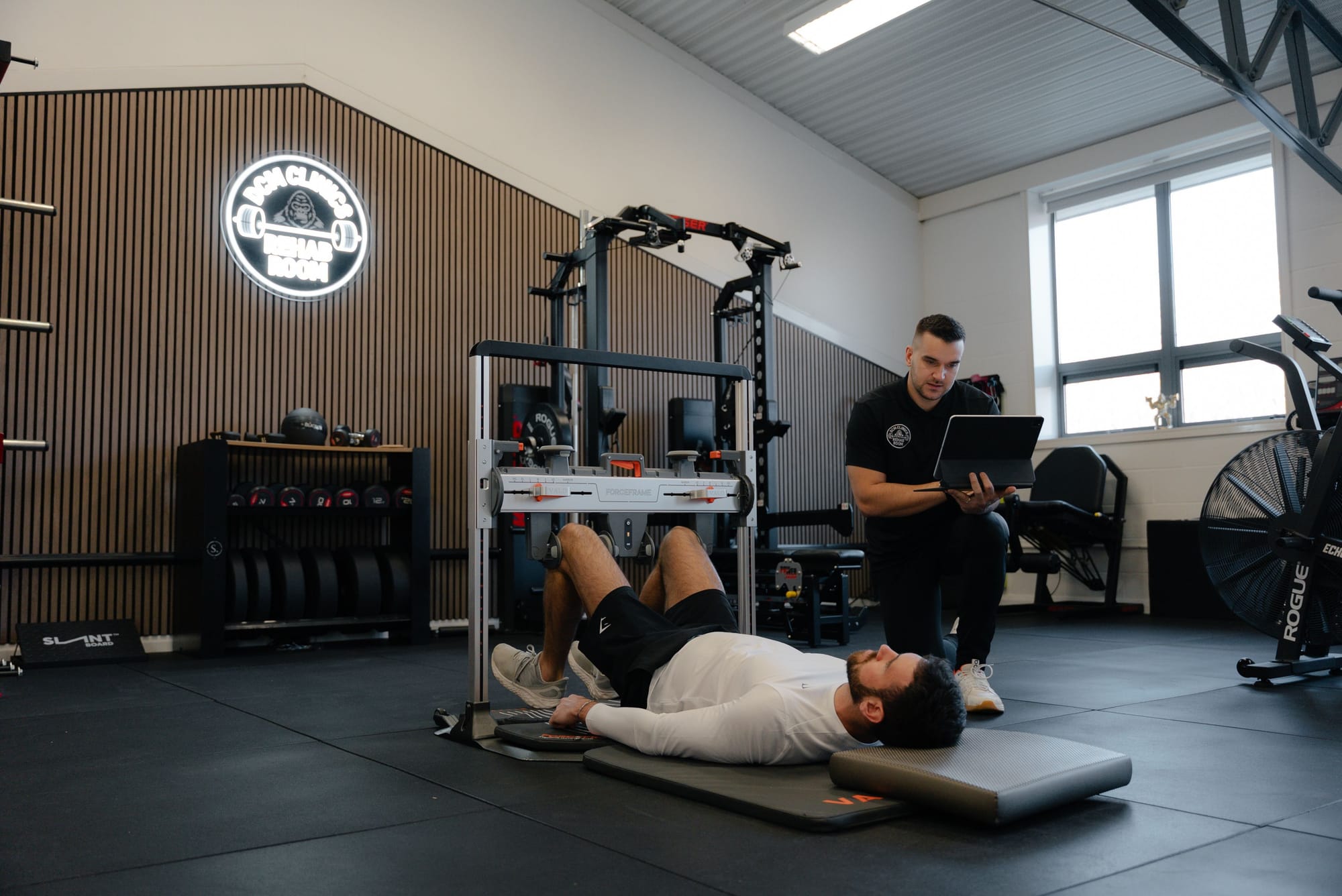
At DCM Clinics, every significant rehab decision runs through hard numbers, not impressions. We use force plate technology (ForceDecks) and controlled strength testing (ForceFrame) to measure what the eye can't reliably see:
- **Left-right asymmetry** in force production, not just "which side looks weaker"- **Rate of force development** — how fast a muscle can produce force, which matters more for sport than raw strength- **Movement quality under load**, tracked frame by frame with 3D motion capture (HumanTrak)
This isn't about chasing gadgets. It's about replacing opinion with evidence at the exact moments that matter most: deciding whether someone is ready for the next phase, or ready for return to sport.
Assess. Build. Re-test.
That's the whole model, in three words.
**Assess** — Before we build a programme, we measure baseline. Where is force output. Where is the asymmetry. Where is the compensation hiding.
**Build** — The programme targets the actual deficit, not a generic template. A patient with a 15% single-leg asymmetry gets a different plan than one with a 30% asymmetry, even with the same diagnosis.
**Re-test** — Progression isn't decided by how many weeks have passed. It's decided by whether the numbers say the tissue and the movement pattern are ready. If they're not, we don't move on — regardless of how the patient feels.
Why this matters for return to sport
Time-based rehab ("you're 12 weeks post-op, you're cleared") is still common, and it's still a guess. Two patients at 12 weeks can have completely different force outputs, different asymmetries, and completely different injury risk.
Testing removes the guess. A re-test gate means a patient only progresses to the next phase — or back to full training — when the data confirms they're ready, not when the calendar says so.
The takeaway
Rehab built on objective testing isn't slower or more complicated. It's more honest. It tells you exactly where a patient stands, exactly what to build next, and exactly when they're ready to go again — no guessing required.
DCM Clinics uses ForceDecks, ForceFrame, and HumanTrak for objective, data-led assessment across every stage of rehabilitation and performance care. To book an assessment.